
Accessory Dwelling Units (ADUs) are one of the smartest investments a homeowner can make, adding rental income, multi-generational living space, and long-term property value. But even well-researched homeowners are regularly blindsided by commonly overlooked costs that aren’t included in standard contractor bids. These surprises don’t just strain budgets; they delay timelines, stall permits, and sometimes kill projects entirely.
If you’re planning an ADU build, this guide covers the five most commonly overlooked line items. These items usually are missed during pre-construction and at the start and can add tens of thousands of dollars in unplanned costs to an ADU project.
#1: Sewer Lateral Replacement
What it is
The sewer lateral is the underground pipe that connects your home’s plumbing to the public sewer main at the street. When you add an ADU, your builder will typically quote connecting your ADU’s plumbing to the existing lateral for your home. If your lateral is undersized, broken, blocked, or otherwise compromised, you could be looking at thousands in replacement costs before you can occupy your ADU.
Why homeowners miss it
Sewer laterals are underground and out of sight. Most homeowners have never thought about theirs unless they’ve had a backup. A full replacement of the lateral is rarely included in your ADU’s price unless the General Contractor is extremely diligent and performed an inspection before bidding the project.
What it can cost
Sewer lateral replacement typically runs between $5,000 and $25,000+, depending on the distance from your home to the main, the depth of the line, the soil conditions, and the method of replacement. Some laterals can be replaced using trenchless methods which can save time and money by not requiring the plumbing or excavating contractor to excavate your yard and the street. However, if your lateral his broken, misaligned, or has a belly in it, you will require an open cut replacement.
What you Can Do
Before putting your project out to bid, hire a licensed plumber or general engineering contractor (like us!) to run a sewer scope (video inspection) of your existing lateral. This $200–$400 inspection can save you tens of thousands in surprises. Provide the scope report to all the general contractors who are bidding the work to make sure they include the replacement of the lateral in their bid. Check with your local building department to confirm whether a lateral inspection is required as part of the ADU permitting process — many cities now mandate it.

#2: Electrical Service Upgrade (Panel Upgrade)
What it Is
Adding an ADU means adding a new kitchen, HVAC system, laundry, and general living space all of which increase the electrical load on your existing service. In many cases, your existing electrical panel simply won’t have the capacity to support both the main house and the new unit, especially if your panel only has a 100 Amp main breaker. A service upgrade involves replacing your current panel with a higher-amperage unit, and potentially upgrading the service entrance from the utility pole or transformer.
Why homeowners miss it
Homeowners rarely go into their panel, and if they do, it’s to flip a breaker that tripped. Most folks don’t know what their panel is rated for, so there is confusion and shock when the ADU pricing includes several thousand dollars to upgrade a panel. Also, most homes in the Bay Area are older, with smaller, and potentially dangerous, panels.
What it can cost
A standard panel upgrade from 100A to 200A costs $5,000 to $7,000 if your service is overhead (i.e you have wires coming from a telephone pole to your house through the air). If your service is underground or if the utility or your city requires new infrastructure (transformer upgrades, new meter sockets, or a second meter for a separately metered ADU), costs can climb to $10,000 or more. You may also need to go higher than 200 amps, which can also raise the price. Most jurisdictions are now requiring arc-fault and ground-fault circuit interrupter (AFCI/GFCI) circuit breakers for any new circuits, which can also increase costs.
How You Can Prepare
Have a licensed electrician perform a load study on your current electrical system before finalizing your ADU design. If you’re planning to separately meter the ADU for rental purposes (which increases rental desirability and simplifies billing), factor in the cost of a second meter and coordination with your utility company early in the process to avoid surprise fees and excessive delays. Make sure your general contractor also includes any costs related to upgrading the panel in their pricing.
#3: Water Service Upgrade
What it is
Just as with electrical, your existing water service line — the pipe that runs from the city water main to your home — may not be sized adequately to serve both the main house and a new ADU simultaneously. Older homes often have ¾-inch or even ½-inch service lines, while a home plus ADU combination typically requires a 1-inch or larger line. Your local water district may also require a separate water meter and dedicated service connection for the ADU, depending on zoning and rental regulations. Some ADUs also require fire sprinklers, especially in areas located in the Wildland-urban interface. This alone will trigger at least a water meter size upgrade.
Why homeowners miss it
Most folks have no idea what size their meter is or what size pipe feeds their home. The water line is buried, it works fine for the existing house, and it’s not top of mind when folks are thinking about putting in a new ADU. The issue surfaces during plan check, when the building or utility department reviews the proposed fixture count against the existing service capacity. If your ADU requires a new meter, sometimes designers are not informed of the requirement and fail to take this into account before plan check.
What it can cost
A water service upgrade — including trenching, new meter installation by the utility, and backfill — typically costs $3,000 to $15,000, and can run higher if the main is far from the house, the site is in dense urban infill, or a new tap into the city main is required. If you need to add a second meter connection for your ADU, you will also need to factor in the water district connection fees, which can add $5,000 to $20,000+ in some California jurisdictions on top of the cost of actually installing the meter and line.
How You Can Prepare
Contact your local water district early in the design phase and ask two questions: (1) Is a separate water meter required for an ADU on my parcel? (2) Is my current service size adequate for the added fixture count? Get these answers in writing before your permit is submitted. Also ask your designer or the building department if your area requires installing fire sprinklers in your ADU.
#4: Grading and Land Clearing
What it is
Before any foundation can be poured, your ADU site needs to be properly prepared. This means clearing vegetation, demolishing existing structures (old garages, sheds, patios, or pools), and grading the land to achieve the correct slope for drainage, foundation bearing, and compliance with local grading codes. Poorly graded sites lead to flooding, foundation failure, and failed inspections.
Why homeowners miss it
You may look at your backyard and see flat, open space — not a grading project. But even seemingly flat lots often have drainage issues, compacted or expansive soil, buried debris, tree roots, or inadequate slope away from structures. Sometimes the foundation design means additional material needs to be brought in or taken out, which can really eat into a budget.
What it can cost
Basic grading and clearing for a modest ADU site can run $5,000 to $15,000 if the site requires no or minimal import or offhaul. If the site requires significant regrading, retaining walls, soil export, or soil remediation, costs can easily reach $20,000 to $60,000. In hillside or sloped lots, grading and foundation work often becomes the most expensive single line item in the entire project.
How you can prepare
Hire a licensed civil engineer or geotechnical engineer to evaluate your site before finalizing your ADU plans. A soils report (geotechnical investigation) costs $1,500–$4,000 but is often required by the building department anyway and it will tell you exactly what the site preparation scope will be. Don’t let your design get finalized around a foundation type that the soil can’t support. Understanding what dirt you need to move before you finalize your design can help you and your design team make decisions to minimize the grading scope, allowing you to put more of your budget into the interior of the structure instead of moving dirt around.
#5: Additional Trenching to Extend Utility Services to the ADU
What is it
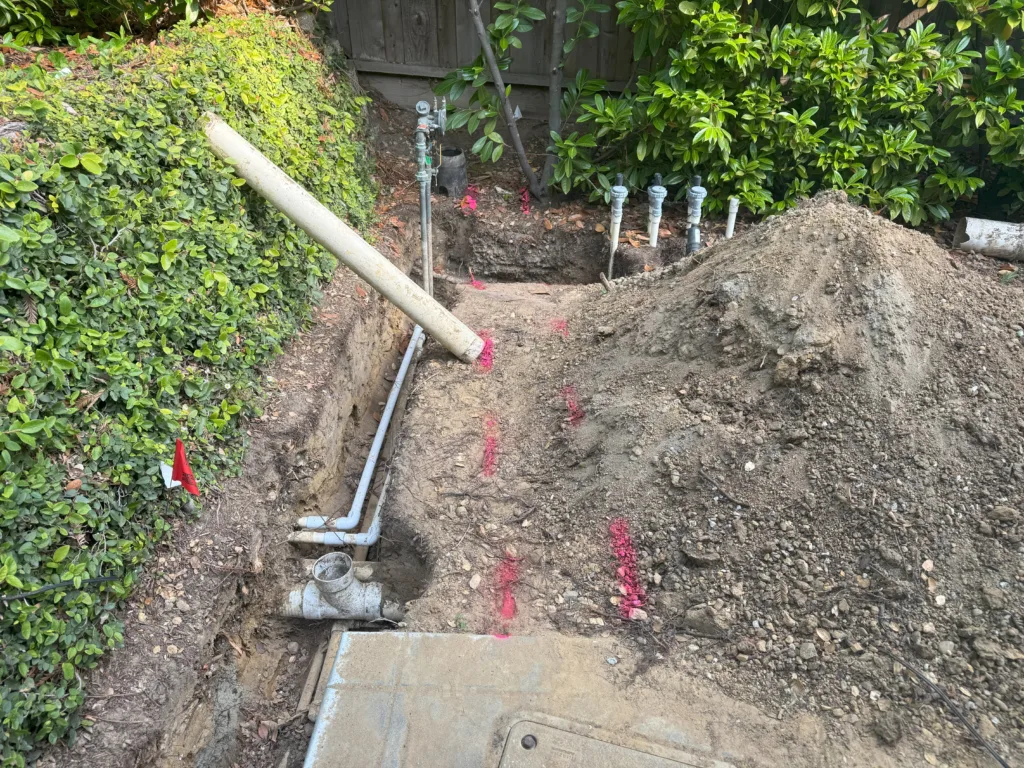
our electrical panel, gas line, water service, sewer lateral, and communications infrastructure all originate at or near your main house. An ADU — whether it’s a detached backyard structure, a garage conversion with a new foundation, or a new construction unit — needs all of those utilities extended to it via underground trenching. This includes:
- Low-voltage conduit for internet
- Electrical conduit from the main panel (or a new subpanel) to the ADU
- Water supply line from the main house or a new service connection
- Sewer lateral connection tying the ADU into the existing or new lateral
- Gas line extension (if the ADU will have gas appliances)
Why homeowners miss it
Each of these utilities is usually handled by a different subcontractor (electrician, plumber, gas contractor), and each may include some trenching in their individual bid — but the coordination, total linear footage, and compounding cost of running multiple utility lines across a property is rarely captured as a single line item.
What it can cost
Utility trenching costs are driven by linear footage, depth requirements, soil conditions, and whether existing hardscape (concrete, pavers, or asphalt) must be cut and restored. Expect to budget $75 to $200 per linear foot for open-cut trenching with backfill and compaction. A detached ADU 60 feet from the main house may require 300+ linear feet of combined utility runs when you account for all systems — easily adding $20,000 to $50,000 to your project before a single framing nail is driven.
How You Can Prepare
Ask your contractor or engineer to produce a utility routing plan early in design. Map out where every utility connection originates and what path it will take to reach the ADU. Look for opportunities to consolidate trench routes (running multiple conduits in a single trench dramatically reduces cost), and flag any areas where hardscape demolition and restoration will be required.
Don’t Wait For These Costs to Show Up
We Know – These 5 items are probably the least exciting part about building an ADU. You are either going to bury or promptly forget that all of this infrastructure exists once your ADU is built. However, as we have detailed above, failing to take into account any or all of these items can easily add $50,000 to $100,000+ to the final cost of constructing your ADU. These are also critical to the functioning of your ADU. If you can’t turn on the lights or flush the toilet, you probably don’t want to live in your new ADU.
Why Bay Area Homeowners Choose Harris Excavation
Harris Excavation is a Peninsula-based earthwork company specializing in residential drainage solutions, grading, and excavation. We know Bay Area soils, Bay Area rainfall patterns, and Bay Area properties — because we’ve been working in these communities for years. When you work with us, you get honest assessments, transparent project scoping, and ADU earthwork solutions built to last a lifetime.
Serving residential homeowners across the Bay Area Peninsula including San Mateo County and Santa Clara County.
Thinking about adding an ADU to your property? Contact Harris Excavation today for a professional site assessment. We’ll walk your property with you, identify Areas of Concern, and give you a clear picture of what you can expect for earthwork to make your ADU dreams a reality.

Leave a Reply