
Most people pick a driveway by the surface: concrete, asphalt, pavers or gravel. But the surface is the last few inches of the job. Whether it cracks, sinks, puddles or sends water into your garage is decided underneath, by the grading.
Driveway grading is the work of shaping the ground so the driveway has the right slope, sits on a solid compacted base, and moves water where you want it to go. With those right, almost any surface will last; with any of them wrong, even good concrete fails early. On a Bay Area property, all three should be settled before anyone pours or paves.
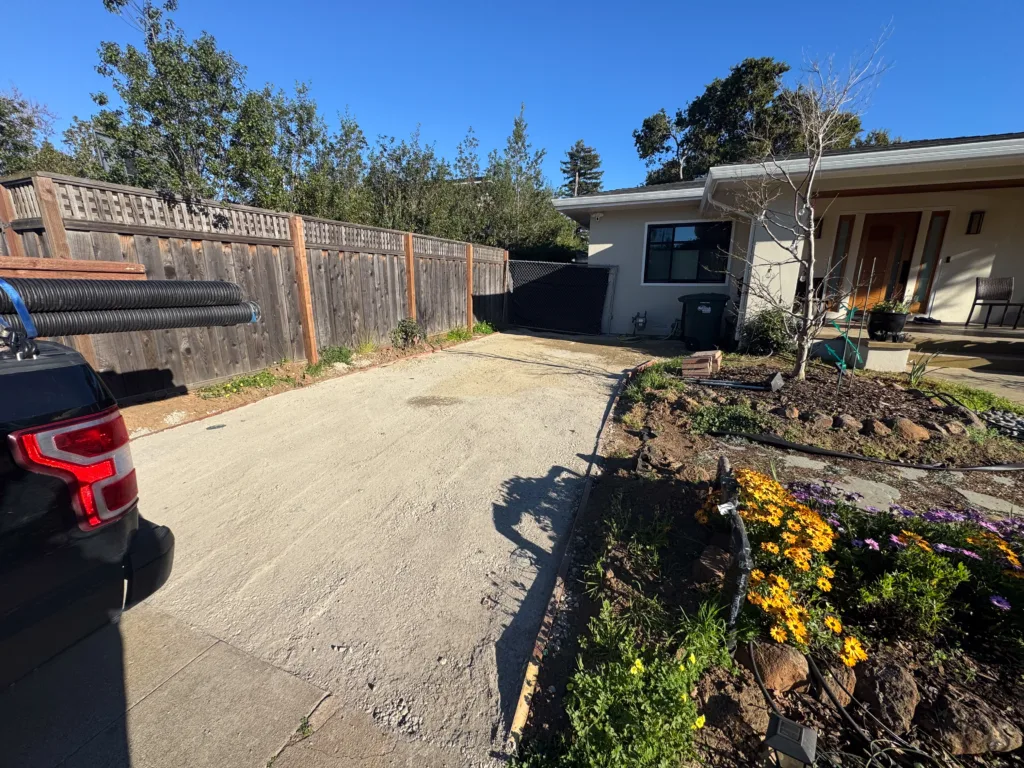
Step 1: Get the slope right
A perfectly flat slab holds water, and water sitting on a driveway soaks into joints and cracks and works its way under the base. So every driveway needs some fall. How much, and in which direction, depends on where the house and the drains are.
Slope away from the house
Water should never run toward your foundation. The California Residential Code (Section R401.3) requires lots to be graded to drain water away from foundation walls, and says impervious surfaces within 10 feet of the foundation must slope at least 2 percent away from the building. A driveway that runs alongside the house or up to an attached garage counts.
Two percent is about a quarter inch of fall per foot. It doesn’t look like much, but it’s enough to keep water moving. On the job, we check it with laser layout tools rather than by eye, because a driveway that looks flat can easily be pitched the wrong way.
Cross-slope and crown
A driveway can shed water along its length, across its width, or both. Long, straight driveways are often given a cross-slope to one side, or a slight crown down the middle, so rain runs off the edges instead of racing down the full length and pooling at the garage door or the street. Pick the low edge together with the drainage plan in Step 3, since that edge is where the water ends up.
How steep is too steep?
On hillside lots, the limit is often set by the fire code. Where California’s State Minimum Fire Safe Regulations apply, generally in State Responsibility Areas and Very High Fire Hazard Severity Zones, driveway grades can’t exceed 16 percent. The local jurisdiction can approve up to 20 percent, but only with mitigations. Many cities and fire districts have their own driveway standards too, so check yours early.
Sharp changes in grade, such as where a steep driveway meets the street or a flat garage slab, are where cars scrape, so a good grading plan smooths those transitions.
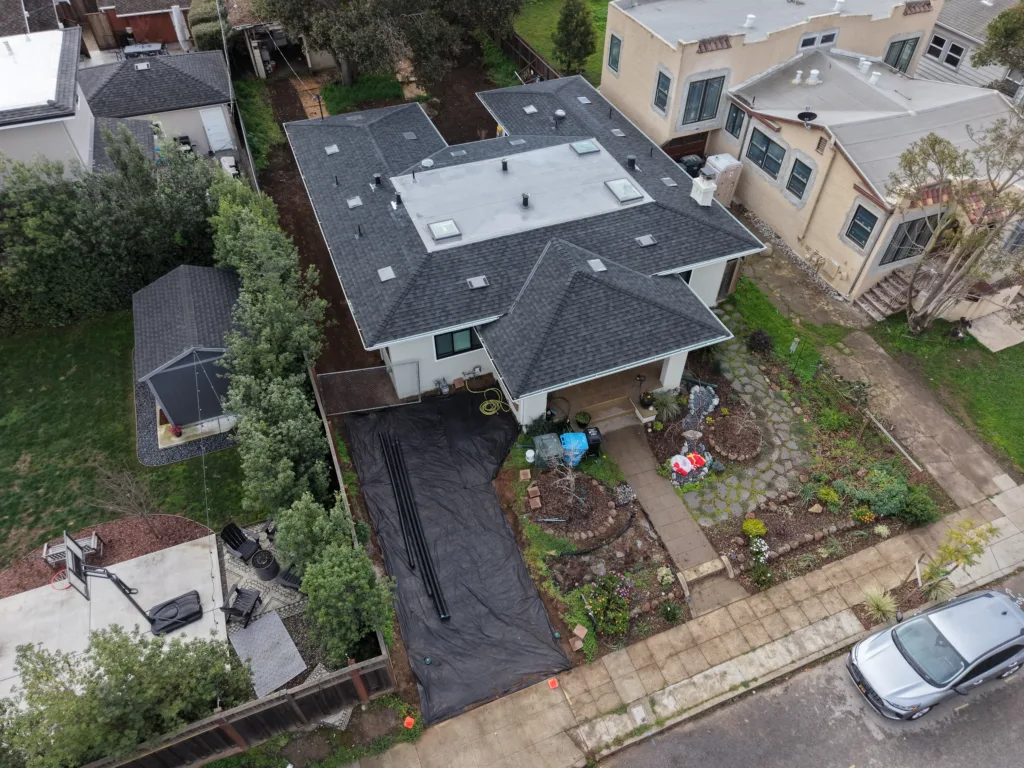
Step 2: Build a base that won’t move
Cracks, dips and ruts usually mean the ground under the driveway settled, stayed wet, or was never compacted properly. Once the surface goes down you won’t see the base again, and fixing it later means tearing the surface out.
Prepare the subgrade
The subgrade is the native soil the driveway sits on. Before any base rock goes in, the area is excavated to depth and the subgrade is cleaned up and shaped to the same slope as the finished driveway. That means removing:
- Topsoil, sod and anything organic, which compresses and rots over time
- Roots and stumps, which leave voids as they decay
- Soft or saturated soil that pumps or moves under a roller
- Old asphalt, concrete or debris left from a previous driveway
Many Bay Area properties sit on clay that swells when wet and shrinks when dry. On those sites, getting the subgrade right, and sometimes bringing in a soils engineer, can matter more than anything you put on top.
Place and compact the base rock
On top of the subgrade goes a layer of aggregate base, commonly Class 2 aggregate base in California. It spreads the weight of vehicles and gives the surface a uniform, stable bed. How thick it needs to be depends on your soil, the surface you’ve chosen and the loads it will carry, so take the thickness from your plans or your engineer.
Base rock has to be compacted, and compacted in layers, called lifts. Public works specs set a high bar: Palo Alto’s aggregate base specification (opens in new tab), for example, calls for each layer of Class 2 base to reach at least 95 percent relative compaction. Hitting that takes the right compaction equipment, rock at the right moisture, and usually more than a few passes with a plate compactor.
Step 3: Plan where the water goes
A new driveway is a large hard surface, and every storm sends its runoff somewhere. Slope gets the water moving; the drainage plan decides where it ends up. That plan should keep it away from the house, off your neighbor’s property, and out of the base under the driveway.
Common ways to handle driveway runoff include:
- Sloping the driveway toward a landscaped area that can soak up the water
- A trench drain across the driveway where it meets the garage, for driveways that slope toward the house
- Catch basins at low spots, piped to an approved discharge point
- Swales or a culvert along longer driveways on sloped or rural lots
- Permeable pavers or gravel, which let some water soak through instead of running off
If the garage sits below the street, runoff from the street end of a down-sloping driveway heads straight for the garage door. These driveways almost always need a drain at the bottom and a place for that water to go.
Driveway drainage works best when it’s planned with the rest of the yard. Our residential grading work treats the driveway subgrade and the surrounding grades as one system, so water from the driveway doesn’t create a new problem somewhere else.
Permits, approaches and other details
Permit rules for driveways vary by city and county across San Mateo and Santa Clara Counties. A few things commonly come up:
- Work in the public right-of-way, like a new or widened curb cut and approach, usually needs an encroachment permit from the city or county
- Larger cuts and fills, especially on hillsides, can trigger a grading permit
- Fire districts may review width, grade and turnarounds on long or steep driveways
- Protected trees near the driveway can bring tree protection requirements during excavation
Call your local building or public works department before you start. It’s much easier to design around a requirement than to tear out work that didn’t meet it. For a broader look at how grading projects are scoped and priced, see our guide to grading your property and what it costs.
When to bring in a grading contractor
A short gravel pad on flat ground can be a weekend project. For most new driveways, call a contractor when:
- The driveway is on a slope, or slopes toward the house or garage
- You’re paving with concrete or asphalt and need a base built and compacted to spec
- The soil is clay, wet or full of old fill
- There’s soil to haul off, or a drain, culvert or trench drain to install
- The work needs a permit or an inspection
Harris Excavation handles the earthwork under the driveway: excavation, subgrade prep, base rock, compaction and drainage, with slopes set by laser. That leaves your concrete, asphalt or paver installer with a firm, correctly pitched base to build on.
Driveway grading FAQ
How much slope does a driveway need to drain?
Within 10 feet of the house, the California Residential Code requires hard surfaces to slope at least 2 percent away from the foundation, about a quarter inch per foot. Beyond that, the right slope depends on the site and the drainage plan.
What is the maximum slope for a driveway in California?
Where the State Minimum Fire Safe Regulations apply, driveway grades are capped at 16 percent, or up to 20 percent with local approval and mitigations. Cities and fire districts may set their own limits, so check with yours.
What goes under a new driveway?
A prepared, compacted subgrade with organics and soft soil removed, then a layer of compacted aggregate base, commonly Class 2 base rock. The thickness depends on the soil, the surface and the loads.
Why is my driveway cracking or sinking?
The most common causes are a base that wasn’t compacted, organic material or soft soil left under it, and water getting into the base because of poor slope or drainage. A lasting fix usually means repairing the base, since a surface patch leaves the cause in place.
Planning your driveway grading project
Harris Excavation grades driveways across San Mateo and Santa Clara Counties, setting the slope, base and drainage before your installer pours or paves.
Tell us about your driveway project, where it is and what surface you’re planning, and we’ll put together a free quote.
