
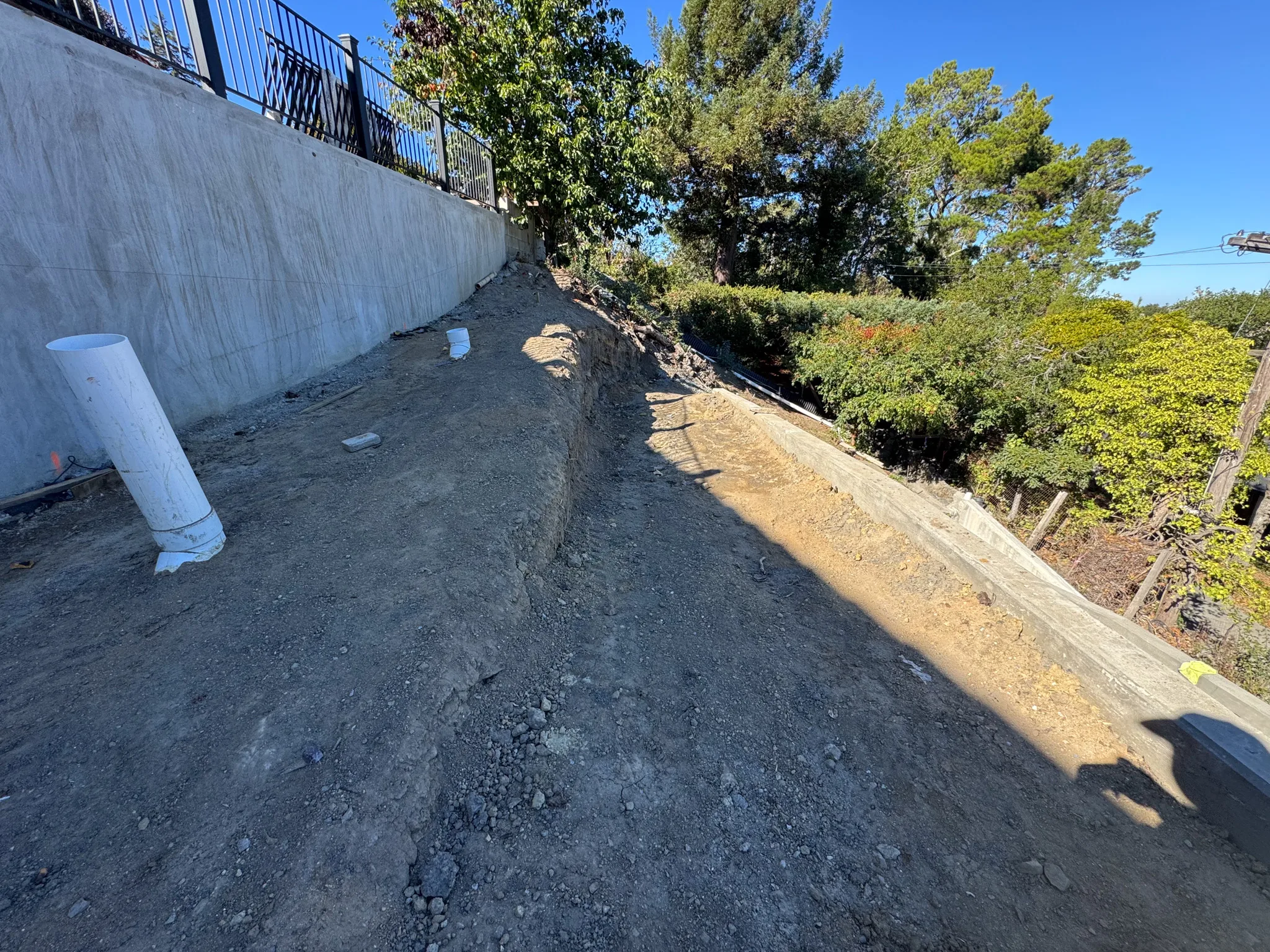
In the Bay Area, the first real storm of the season is when a hillside shows you what it’s made of. Bare soil, a new cut, or a slope that lost its ground cover over the summer can start sliding downhill one rain at a time. Mud ends up on your patio, against your foundation, in the street drain or in your neighbor’s yard.
Good hillside erosion control in San Mateo County isn’t complicated, but it does have a deadline. The County treats October 1 through April 30 as the wet season, so the time to cover soil, slow down runoff and fix drainage is before the big storms line up, not after the first gully shows up.
This guide covers why slopes erode, the County’s wet-season rules, the practical steps that hold soil in place, and the signs that it’s time to bring in an excavation contractor.
Why Hillsides Erode When the Rains Come
Erosion starts with water impacting bare dirt. Each gallon knocks soil particles loose, and once the ground is saturated, water starts running off the surface and carrying that loose soil with it. On a slope, runoff picks up speed, and faster water carries more soil.
A few things make it worse on Bay Area hillside lots:
- Bare or disturbed soil. Fresh grading, a summer landscaping project, a dug-out utility trench, or dead vegetation leaves soil with nothing protecting it.
- Concentrated water. Downspouts, driveway runoff and overflow from the lot above get funneled into one spot. A single stream of water cuts a gully much faster than rain spread across a slope.
- Long, uninterrupted slopes. The longer water runs downhill without anything slowing it, the more energy it has when it reaches the bottom.
- Slow-draining clay. Much of the Peninsula has clay soils that soak up water slowly, so more rain runs off the surface instead of soaking in.
What starts as small rills can turn into gullies, undercut retaining walls, and mud piled against your house.
San Mateo County’s Wet-Season Rules
If you’re doing permitted work, the rules are specific. San Mateo County’s erosion and sediment control requirements apply to projects with work during or just before the wet season, which the County defines as typically October 1 through April 30. Its erosion control checklist says to:
- Do clearing and earth-moving only during dry weather.
- Stabilize all bare, disturbed areas and keep erosion controls in place and maintained continuously from October 1 through April 30.
- Keep erosion and sediment control measures in place year-round, not just in winter.
- Skip plastic sheeting during the wet season, except on stockpiles that are also ringed with fiber rolls at the base.
Those rules come from the County’s Planning and Building Department and cover unincorporated areas. Cities set their own grading and erosion rules, and some hillside cities restrict winter grading outright. Our Millbrae excavation and grading page walks through one city’s seasonal grading limits. Before any dirt moves, check with the city or the County about what applies to your parcel.
Even if your project doesn’t need a permit, the same practices protect your property, your neighbors and the storm drain system.
Hillside Erosion Control Steps to Take Before the Storms
Most of what keeps a slope in place comes down to three things: cover the soil, slow the water, and send concentrated runoff somewhere safe.
1. Cover Bare Soil
Bare dirt is the first thing to fix. UC Master Gardener guidance from Marin County recommends covering exposed soil with a heavy organic mulch such as wood chips, and planting deep-rooted ground covers, shrubs and natives on gentler slopes. It also warns against finely shredded bark, which can be a fire risk. Plants take time to establish, so mulch is your first line of defense this fall.
2. Break Up the Slope With Fiber Rolls
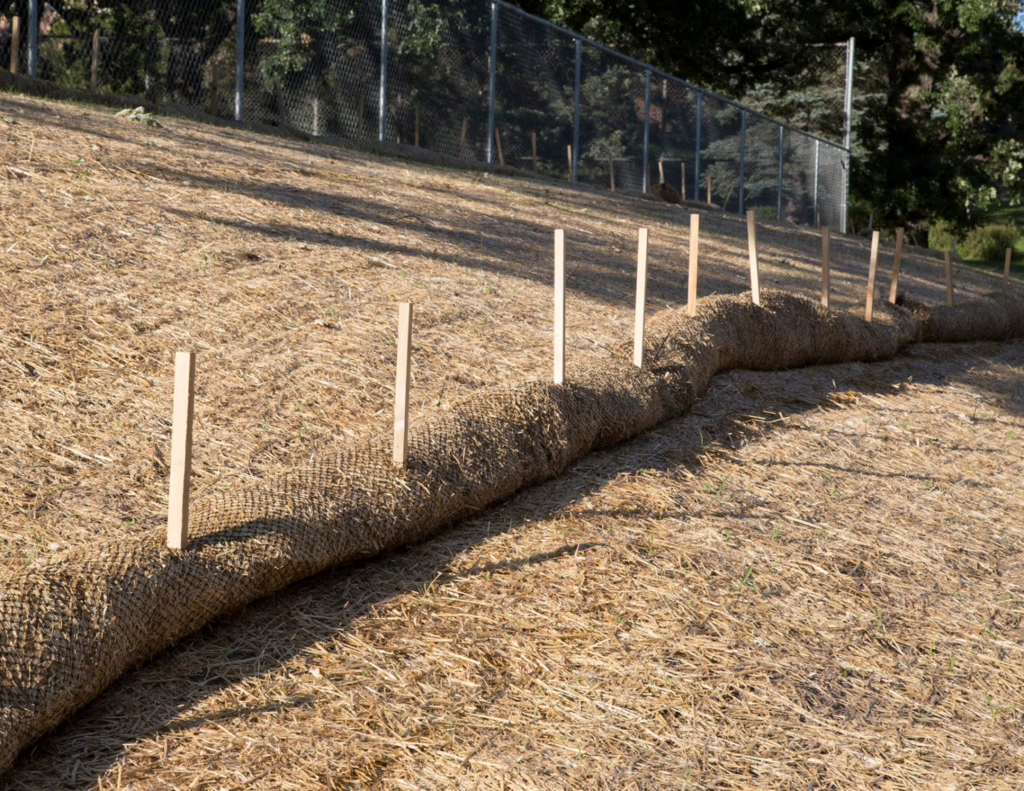
Fiber rolls, often called straw wattles, are tubes of straw or other fiber wrapped in netting. Laid across the slope along the contour, slightly trenched in and staked, they slow runoff and catch soil before it travels downhill. On steeper slopes, the same UC guidance suggests pairing plantings with temporary supports like jute netting and straw wattles until roots take hold.
3. Control Where the Water Goes
Erosion is usually a drainage problem first. Check that downspouts don’t dump onto bare slopes, that driveway runoff isn’t sheeting down the hill, and that water leaving your lot has a stable outlet. A swale, a buried downspout line or a French drain can collect water and move it where it won’t do damage. Our residential drainage work covers all of these.
4. Protect Stockpiles and Open Work
Any pile of dirt or base rock left on site over winter is a mud flow waiting for a storm. Cover it, ring it with fiber rolls, and keep it away from storm drains and the top of slopes. Backfill open trenches before the rains, or stabilize them if they have to stay open.
5. Walk the Slope After Every Storm
Erosion control isn’t set-and-forget. After each storm, look for new rills, fiber rolls that have been undercut or overtopped, mulch that’s washed away, and water ponding where it shouldn’t. Small repairs early in the season are much cheaper than a slope repair in February.
When to Call an Excavation Contractor
Mulch and fiber rolls handle a lot, but some problems need equipment and a plan. It’s time to bring in a pro when you see:
- Gullies that come back after every storm, or soil washing out from under a patio, walkway or retaining wall.
- Cracks at the top of a slope, a bulging or leaning wall, or ground that looks like it’s moved.
- Water from your lot, or the lot above, running against your foundation.
- A slope too steep to hold with plants alone. UC guidance points to retaining walls or terraces for slopes steeper than about 50 percent (a 2:1 slope), and taller walls often need permits and an engineer.
- A grading or construction project that will leave soil exposed into the wet season.
Often the lasting fix is regrading so water drains away from the house and off the slope at a controlled spot. Our guide to grading your property explains what that involves. For builders and property managers, our commercial erosion control team installs and maintains silt fence, fiber rolls and other BMPs on active job sites.
Frequently Asked Questions
When should hillside erosion control be in place in San Mateo County?
Before the wet season starts. The County treats October 1 through April 30 as the wet season and requires permitted projects to keep disturbed areas stabilized through that whole period. If you’re reading this after October 1, it isn’t too late, but don’t wait for the next storm.
Can I use plastic sheeting to cover a slope?
For permitted work in the County, the erosion control checklist doesn’t accept plastic sheeting during the wet season, except on stockpiles that also have fiber rolls around the base. Plastic also sends all the water to the bottom of the slope at once. Mulch, erosion control blankets and plants are usually better choices.
Do I need a permit for erosion control work?
Mulching, planting and placing fiber rolls usually don’t. Regrading, cutting into a slope, building retaining walls or moving larger amounts of soil often do, and the rules vary by city. Check with your city or the County before you dig.
How do I know if my slope is unstable?
Watch for cracks near the top of the slope, leaning trees, fences or walls, bulging soil at the bottom, or new seeps of water. Those are signs to get a geotechnical engineer and a contractor to look at it, not just more mulch.
Get Your Hillside Ready for the Rains
Harris Excavation is a licensed General Engineering Contractor (CSLB #1117960) based in South San Francisco. We handle grading, drainage, excavation and erosion control on hillside lots across San Mateo and Santa Clara Counties, for homeowners, builders and property managers.
If your slope is already moving soil, or you’ve got a project that will leave dirt exposed this winter, send us a quote request with your address and a few photos. We’ll walk the site and send a clear written estimate.
